
News
Explore what’s going on around the industry and get the latest from the world of heavy equipment and earth-moving.
New environmental protection regulations will come into effect in 2025. Integrated smoke and hood machines have become a "must-have" equipment for catering businesses to comply with regulations.
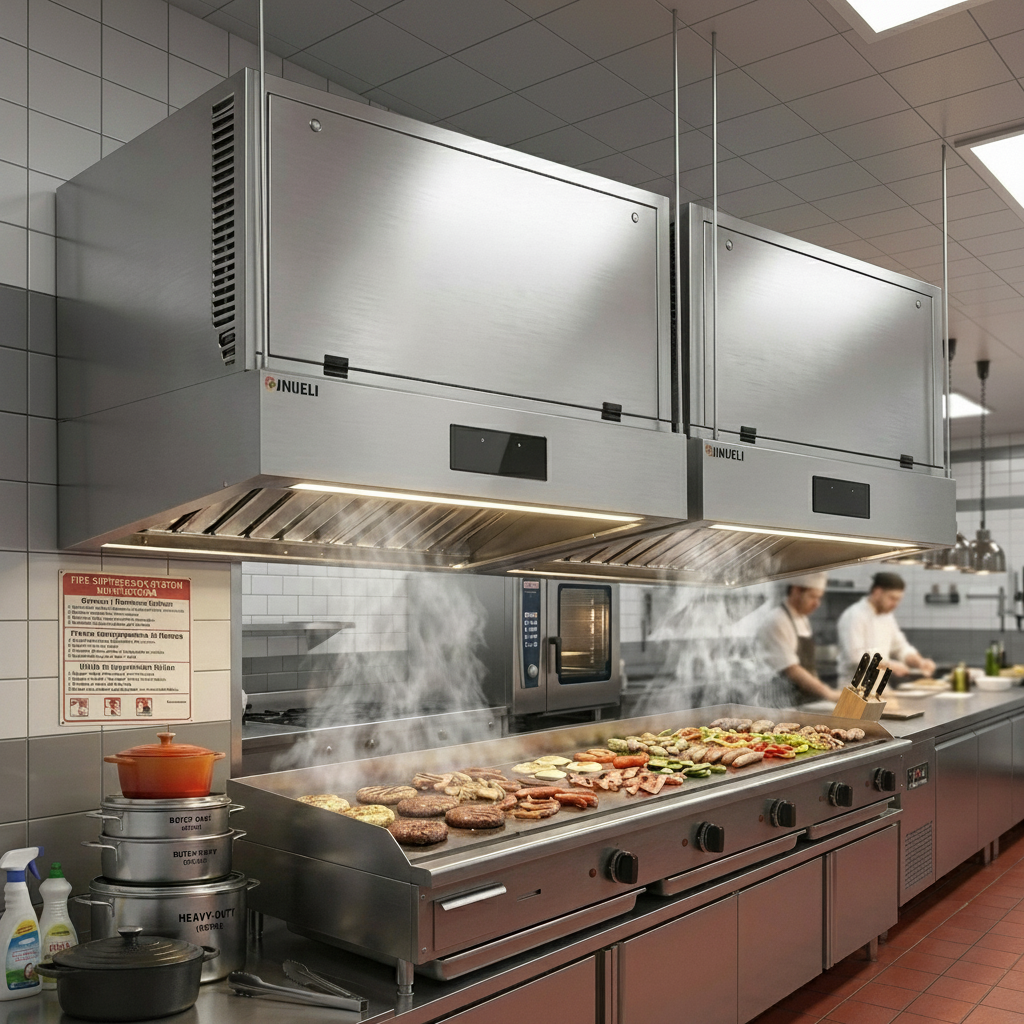
By 2025, all environmental protection regulations will be fully implemented, and the emission standards for restaurant cooking fumes will be further tightened. According to the current "Emission Standards for Cooking Fumes in the Catering Industry" (GB 18483-2023), the concentration of cooking fumes emitted during the operation of integrated smoke hoods must be controlled at ≤ 1 milligram per cubic meter, which is significantly lower than the previous version of the standard. At the same time, the new standard adds clear requirements for particulate matter emissions, stipulating that the emission of particulate matter must be ≤ 5 milligrams per cubic meter, and the concentration of non-methane total hydrocarbons must be limited to ≤ 10 milligrams per cubic meter.
In this context, the integrated smoke hood machine that combines smoking, purification and discharge has become a key equipment for ensuring compliance in the catering kitchen. According to industry experts, the traditional "smoke hood + pipeline" combination has three major problems: high compliance risk - it can only collect smoke but lacks purification function; high maintenance cost - the inner walls of the pipeline need professional cleaning every month, with a single cost exceeding 500 yuan; large space occupation - the complex pipeline design is difficult to fit into a compact kitchen. The integrated smoke hood machine effectively avoids these problems and has become a standard equipment in the catering kitchen.
When choosing a smoke hood integrated machine, experts suggest focusing on three key points: First, policy compatibility is crucial; it must comply with the national standard GB 18483-2001 and have the CCEP certification recognized. Second, material components: the thickness of the stainless steel body should be ≥ 1.2 millimeters. Third, air volume matching: it needs to be precisely calculated based on the size of the kitchen and the type of cuisine.
It is particularly important to note that the integrated smoke hood machines should be cleaned and maintained at least once every three months. For barbecue-based catering projects, due to the large amount of smoke produced, the cleaning and maintenance cycle should be shortened to once a month. Local environmental protection departments remind catering operators to ensure that the equipment is installed in accordance with regulations and operates normally, and to avoid the risk of fines or even suspension and rectification due to non-compliance with regulations.
NAVIGATION
Send Us A Message